It seems every time you meet a plant person they love to ask what your favorite plant is. This is a harder question that one might think. There are more than 375,000 species of plants in the world, and at least 100,000 more cultivars and varieties, which makes making a decision quite difficult. It is obvious from the last blog post the Polly Hill Arboretum Internship was a transformative experience for Eva and Tessa, but were you wondering if they had a favorite plant?
~
New Plants We Love
 |
| The flowers of the Cornus kousa in the Dogwood Allee at the Polly Hill Arboretum. The opposite branching and thick network of leaves and branched gives this tree a pleasing geometric feel. All of the dogwoods in the allee were heavy with beautiful bracts, and inconspicuous flowers, this year. |
Eva- Kousa dogwood (
Cornus kousa). Three words: Origami flower buds. “I’d seen dogwoods, but not the
kousa kind. I’ve kind of fallen in love because we got to see it flower, leaves,
and its bracts full of whiteness, and then they kind of fell off, and then
their fruits are turning red; and it’s just a beautiful spectrum of interest.”
 |
The close-up of a Stewartia malacodendron flower, highlighting the stunning blue anthers and royal purple filaments. I felt a sense of pride knowing this wonderful tree can be found in the southeastern woodlands.
Everyone else should be jealous. |
Tessa- The genus
Stewartia.
“I never knew what a
Stewartia was
before I came here. What I love most about them is their bark. It’s not the
typical ‘oh, their flowers are great,’ because their flowers are beautiful, but
their bark is so interesting to me. So cinnamon-y. Their form is really nice
too, but I’m a sucker for bark. Bark!”
.JPG) |
| Just look at Tessa checking out that really cool Stanhopea orchid at Longwood Gardens. Plants are amazing. |
Amanda- Plants. “This answer is a bit of a cheat, but oh
well. There are tons of favorites in the collection. Literally. Some old loves
rekindled. Some new and unfolding. Some still undiscovered. Every day, every
plant reminds me of some new detail as to why I love plants and horticulture. There
is always something to wonder about. That inspiring wonder is why I love them and being at Polly
Hill is a constant reminder of that.”
~
Favorite Places in
the Arboretum
 |
Cornus kousa Allee at the Polly Hill Arboretum in June.
It's hard to imagine it was planted more than 40 years ago in a grass field. |
Eva- The Dogwood Alleé. “We walk through that every day and it’s always beautiful.”
 |
| A view of the Conifer Rows at the Polly Hill Arboretum, looking from the west to the southeast. |
Tessa- The
Conifer Rows. “I never see as many people in
there as there should be. People don’t appreciate conifers, maybe because they
don’t flower, or what, but they’re just silent giants of wonder.”
 |
| The restored nursery area draws a lot of questions form visitors. It inspires a deep sense of appreciation in me because this is where Polly started, or tried to start, all of her seeds and seedlings. This is the birthplace of the Arboretum. |
Amanda- The Nursery Field. “It’s probably because of the
Magnolia macrophylla ’Julian Hill’.
There is something magical about coming around the corner or from underneath
the Dogwood Alleé and looking up into this towering, tropical-looking tree.
However, the Dawn Redwood and some beautiful
Stewartia ovatas are also planted in the field. I will admit that
most people never see most of this area because of the way it is organized, but
it is probably one of the most important because it is where
Polly startedeverything.”
~
Recommendation for Future PHA Interns
 |
| Tessa and Eva being goofy on a concrete toadstool at The Folly, during the Garden Conservancy's Open Garden Days. |
Tessa- “You have to have a sense of humor. If you come to Polly Hill Arboretum and you don’t have a sense of humor, you’re in the wrong place. Well, not in the wrong place, because that’s harsh, but you’re either going to hate it or you’re going to be turned into a different person because you’re going to gain a sense of humor. And be ready to just do a lot of work and keep an open mind. Be prepared to do some tasks for a long time. You have to be prepared to set out and do a task, and finish it. And then you feel a thousand times better when it’s finished anyway. Don’t half-ass anything.”
Eva- “Appreciate all the care that everyone puts into the work they do. The staff and volunteers care so much that you’re here and they want you to learn, so just appreciate that. Be good-natured and don’t be afraid to try anything. Even if there are things that don’t necessarily sound fun, it is enjoyable. You can find a way to enjoy it. Just don’t cancel things out just because you’re afraid to try them. And if you don’t like them, but have to keep on doing them, don’t be a brat about it. Be good-natured.”
 |
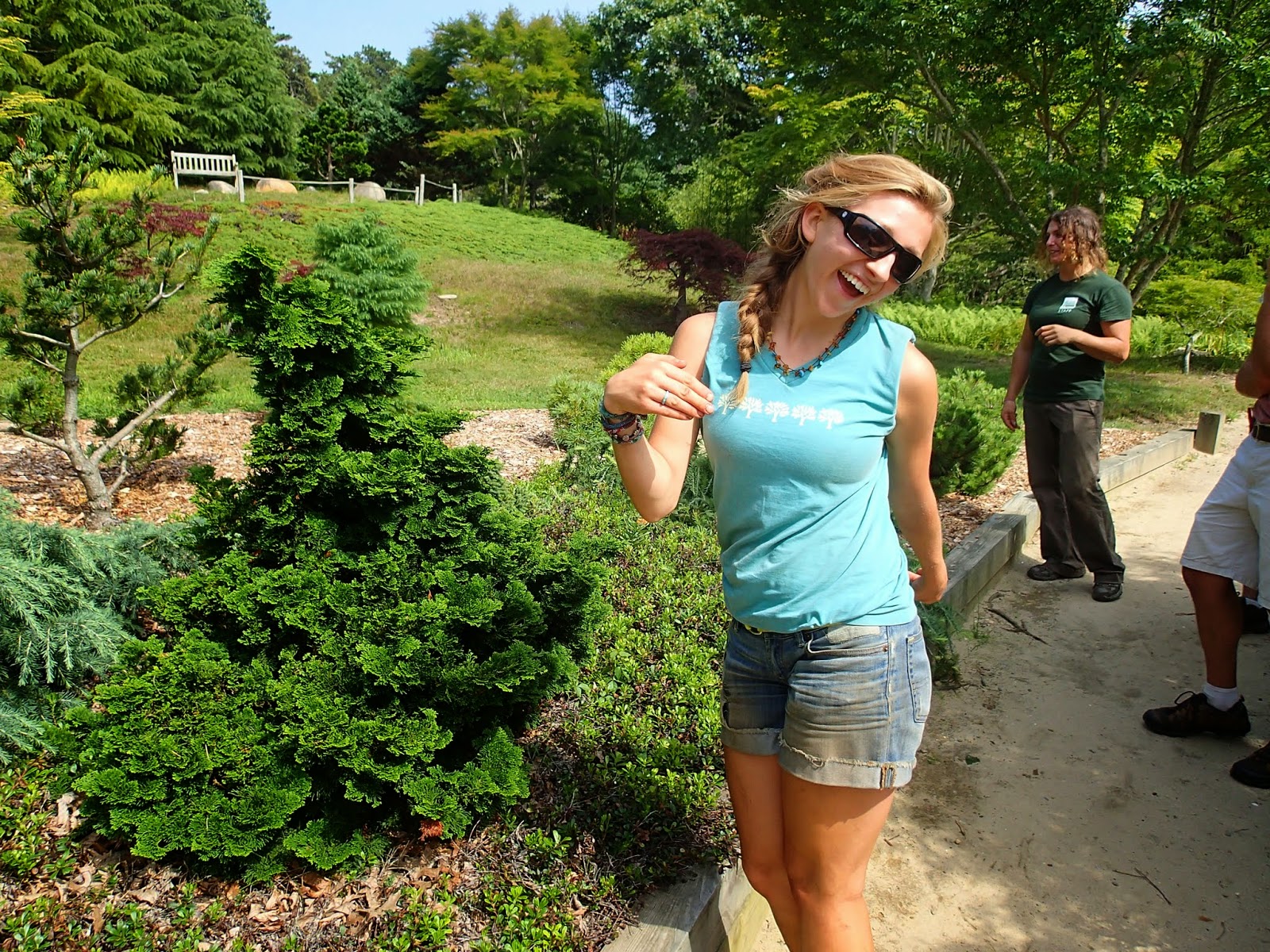
Eva and Tessa exploring Mytoi Japanese Garden on Chappaquiddick Island,
where we saw many Japanese Maples and other manicured conifer cultivars. |
Amanda- “I think Tessa and Eva hit most of the high points. My final recommendation, and this applies to internships and opportunities in the future, is to seize each moment you have and make the most of it. Waiting around for things to happen to you is going to leave you waiting for a long time.
There are opportunities out there for you, you just have to go for them. Sometimes something may not even seem like “an opportunity,” but you have the power to make it into one. Also, don’t forget that everything you do represents who you are to others. Make sure your putting your best
whatever out there.”