Friday, January 2, 2015

Eva Colberg's Adventures in Madagascar: Appreciation in Manakara

Here is part two of Eva's updates. Everything below is Eva's own words. I hope you enjoy!

Check out Eva's Instagram for more photos of Madagascar and her other adventures:
Instagram

If you would like to contact her, feel free to email her here.

~~~


Mada Update #2

Eva Colberg
October 16, 2014

Akory aby! (That's the Antemoro greeting in Manakara, my current location)

Bear with me (or just look at the photos), as this is fairly long.

This is the landscape of southern Madagascar; with spiny thickets and tombs galore.
Most of us agreed that Faux Cap was one of the most challenging experiences; we were divided into pairs to stay in small villages within the same commune, each with a Malagasy student from our partner school as translator. I was extremely lucky to have a good translator, minimal fleabites and no illnesses during my stay, as well as a wise host mother who could sense when we were uncomfortable and then found ways to alleviate it. Fortunately, I enjoy singing and dancing and eating sweet potatoes, because we did a lot of that. Sure, we had time to practice rural appraisal methods and learn about the food security of the area, but over the course of the week I also ate the fruit of the raketa cactus, took bucket showers under the sky behind a wall of sisal (Sisal is a spiky plant commonly found in but not endemic to the landscape of Southern Madagascar. Agave sisalana is commercially grown (more so in the past, but still a bit today) in Madagascar for its tough fibers, which an be used for twine and carpets among other things. - Eva), crowded into a one-room house with 20 other people, planted corn, and spent at least an hour every night dancing with the entire village in the traditional Atandrôy style.

Our Faux Cap host family tressed my hair in their traditional style and we all danced together for the farewell celebration.
After a week that was far too short back in Fort Dauphin, it was time to say goodbye to our host families and move north.
I never realized how privileged we are to have seatbelts, personal space, and paved roads in the States, but despite the absence of those three qualities I am now a master of finding comfort in a camion-brousse. 

We spent the past week camping in front of la StationOcéanographique de Vangaindrano, where we studied coastal ecology and natural resource use within the surrounding community. I thus now have a much better understanding of rice farming, which is widely practiced in this region. Most of the people we talked to were poorer farmers who only own a few fields, and thus can’t let anything fallow for rejuvenation and better future growth.  It seems like a vicious cycle where only those who are already well off can afford the more efficient techniques, but they manage to survive.

On the road after Vangaindrano, we had two forest walks: one at Mahabo, a community-managed multiple-use littoral forest (Missouri Botanical Garden's work in littoral forests -Amanda W.), where I found another orchid in bloom (pictured left); and the other through a low-altitude rainforest populated with palms, mangroves (Conservations efforts -Amanda W.), and epiphytes. Ducking under vines and adventitious roots makes any hike feel more adventurous, especially when you also find chameleons and snakes and bright red millipedes!

I’m currently writing this from Manakara, in my host family’s house. They don’t have Internet or a flushing toilet, and nobody has their own room, but they do have a large house, electricity, and running water, so they’re fairly well off in terms of Malagasy homes.  They’re also incredibly friendly and have emphasized the fact that this is a learning experience from the start; four of them speak French, but they all make an effort to teach me Malagasy and find traditional foods for me to try. This involves a lot of rice flour bread products, fresh fruit juices, and sugary treats.

We've also seen a fair amount of tragedy. My host sister took me to the beach, and right as we arrived a swarm of people was making its way from the water, surrounding the body of a young boy who had just been taken out to sea. They at first thought he was drowned, but he started breathing again. Because no doctors work on weekends, though, he still didn't make it, and ended up dying anyways. It is sometimes difficult to face all the depressing facts about poverty, inadequate governance, and the destruction of nature in Madagascar, but at the same time there is so much joy in all the people; everyone greets each other on the streets, and they are especially delighted when vazaha such as myself and my fellow students respond in not only Malagasy but their own dialect. Even when a Malagasy song is talking about a sad subject, it still unfolds in a cheerful key and tempo. Every day brings new happiness no matter what hardships happen.

Veloma!

Eva

Tiny chameleon!

Thursday, January 1, 2015

Eva Colberg's Adventures in Madagascar: Introduction to the country and conservation

On August 12, Eva Colberg left the Polly Hill Arboretum and Martha's Vineyard for her next big adventure: a three-and-a-half-month-long study abroad in Madagascar. At 2 AM on August 28, she touched down in the country best known for its vanilla and curious prosimians (who like to Move It, Move It) for an amazing, once-in-a-lifetime experience.

She sent her friends and family exciting accounts of her activities while she was there and I was so touched by her experience that I wondered if she would mind sharing it on here. Her reply was yes and so we've arranged to release the updates in a four-part series, which starts with this post. Everything below is Eva's own words. I hope you enjoy!

Check out Eva's Instagram for more photos of Madagascar and her other adventures:

Instagram

If you would like to contact her, feel free to email her here.


~~~


Salama from Madagascar

Eva Colberg
September 20, 2014

Dear all,

Wifi is a rare commodity in Madagascar, but finally I have the chance to show you a bit of my semester!

​For orientation, we started out in the capital, Antananarivo (Tana), taking a few days to see the highlights of the city. In addition to the typical historical walk of Haut-Ville, the former quarter of the rich and royal, and a trip to Tsimbazaza, the national zoo and botanical gardens, we also happened to be there at the same time as the falala (locusts). The sky would grow a hazy reddish brown color every evening from the thickness of the swarms. 

After Tana, we flew south to Fort Dauphin, the easygoing beach town that has been our home base for the month. Our classroom is on a hill at the tip of the peninsula, reachable only by walking across the beach.

We really are learning, though. Everything ties back to the effects of the QMM/Rio Tinto ilmenite (titanium dioxide, the reason fridges and toothpaste are blindingly white) mining project on the people and environment of the region. It has led us everywhere, from speaking with local people displaced by the mine to seeing the mine's property and efforts towards environmental remediation, as well as showing us the places that succeeded in deterring the company and the places that might still become mining land.


We visited Evatraha, a fishing village that was almost the site of a QMM-built port, but local fishermen had enough support to turn down the offer and maintain their capturing waters.

This photo shows the edge of a re-created swamp, one of QMM's more successful revegetation endeavors. Littoral forest revegetation plots from the same year looked significantly less healthy.
QMM wouldn't let my program visit the actual mine this year due to increased safety regulations, but they took us to see their restoration projects and seed bank instead.

We spent a few days at Sainte Luce, camping and learning botanical field methods. My group was lucky enough to find this orchid (pictured above; and of course, Kew would have a field guide; and win for Orchidaceae: it has the most species of any family in Madagascar. -Amanda W.) in our transect.

My Malagasy host family took me to a family funeral, a surprisingly large affair involving lots of food preparation, zebu slaughtering, and carrying of the body to the tomb in the forest. All the women, myself included, wore lamba hoany, the traditional multifunctional and colorful cloth wrap. Most of my communication with the family has been in French, although I am slowly learning Malagasy as well. Thus it isn't complete French immersion, but it's still incredibly helpful.

Up next, after a day-long taxi-brousse ride (my one complaint; outside the QMM-funded pavement of Fort Dauphin, roads here are dusty and riddled with potholes, and driving over them is miserable) we will be spending one week in a rural community in the Faux Cap region, where the people remain far more conservative and traditional than anywhere else we've seen so far. 

Thank you/merci/misaotra,

Eva

Nepenthes madagascariensis, Madagascar's own pitcher plant, growing abundantly on the side of the road.

Thursday, December 11, 2014

Adventures in the Polly Mobile 2: Volunteering at the Smithsonian Gardens' Greenhouse

Bulbophyllum unitubum, Orchidaceae
I had an amazing time at the APGA Plant Collections Symposium in November (I'm probably sounding like a broken record at this point, but anyway...), during which I was able to meet the wonderful people who work with the Smithsonian's orchid collections, Sarah Hadean and Tom Mirenda. They were kind enough to allow me to come out and volunteer with them as I was passing through D.C. and I was more than willing to do so!

I'm such a geek. I was so excited to be repotting orchids (pictured in the background) that I took a picture of the cart. Oh well.
I got up early to beat the insane Washington, D.C. traffic and was rewarded with a beautiful, golden morning. Everyone was so welcoming at the greenhouses and Tom was generous with his time and information. It was great to be there again, despite how brief the work was. It turns out the volunteer training for the upcoming orchid exhibition was today, so I ended up spending the afternoon doing that. It was worth it to see the volunteers and how the staff ran their training. It was also great to hear Tom present about orchids (check out the Embreea collaboration between the Digitization Team and the Orchids Team). He was very informative and entertaining, and reminded me so much of the passionate plant people I dearly miss in Raleigh.

(See the photo slideshow above for more details about the trip!)

Bulbophyllum medusae, Orchidaceae

Wednesday, December 10, 2014

Adventures in the Polly Mobile 2: Exploring Washington, D.C. (again)

Thanks to Couchsurfing and my wonderful host, Matt, I had a comfortable, warm place to rest up before I started my grinding explorations of D.C. On the docket first thing in the morning: riding the Metro to the Library of Congress.

Google Awesome and their really cool panoramas! This is the public entrance to the Library of Congress.
(As always, click above for more photos. I promise they aren't all of architecture. But, D.C. has some nice examples of it. But, I digress.)

As I was about to go into the Library, I noticed there was a protest about GMO labeling on the back steps of the Capitol building. I felt a surge of pride to see people exercising their right to protest.*

Muse of Botany in the Library of Congress
I fell in love with the Jefferson Building of the Library of Congress on my last visit to D.C. I took my time reading the quotes on the wall and reading more about the exhibits they had there. I highly recommend visiting the Library next time you're in D.C. I'm very proud that our country's forefathers, including my man Jefferson, had the foresight to found such an institution.

After my jaunt through history, I was back on the hunt for plants. The U.S. Botanic Garden is on the block next to the Capitol Building, which I think is wonderful (it is under the purview Architect of the Capitol, thus under Congress). I wandered through the National Garden, a collection of Mid-Atlantic plants outside that demonstrated the diversity and beauty of the native plants of the area. I ran into the wonderful curator of the USBG, Bill McLaughlin, whom I'd bonded with over the Hawaiian plants in the conservatory during my trip in November. I even met a beautiful golden patch of Solidago plumosa, my topic plant in my Rare Flora of North Carolina class (please, please, please check out my manifesto).

I made my way into the conservatory to see what had been changed out since I'd been in November. The economic plant hall was looking especially decorative for the Christmas season and the rare plants were still looking good. I was especially impressed with the Poinsettia display showcasing the historical cultivars that led to modern-day staples. Excellent signage.

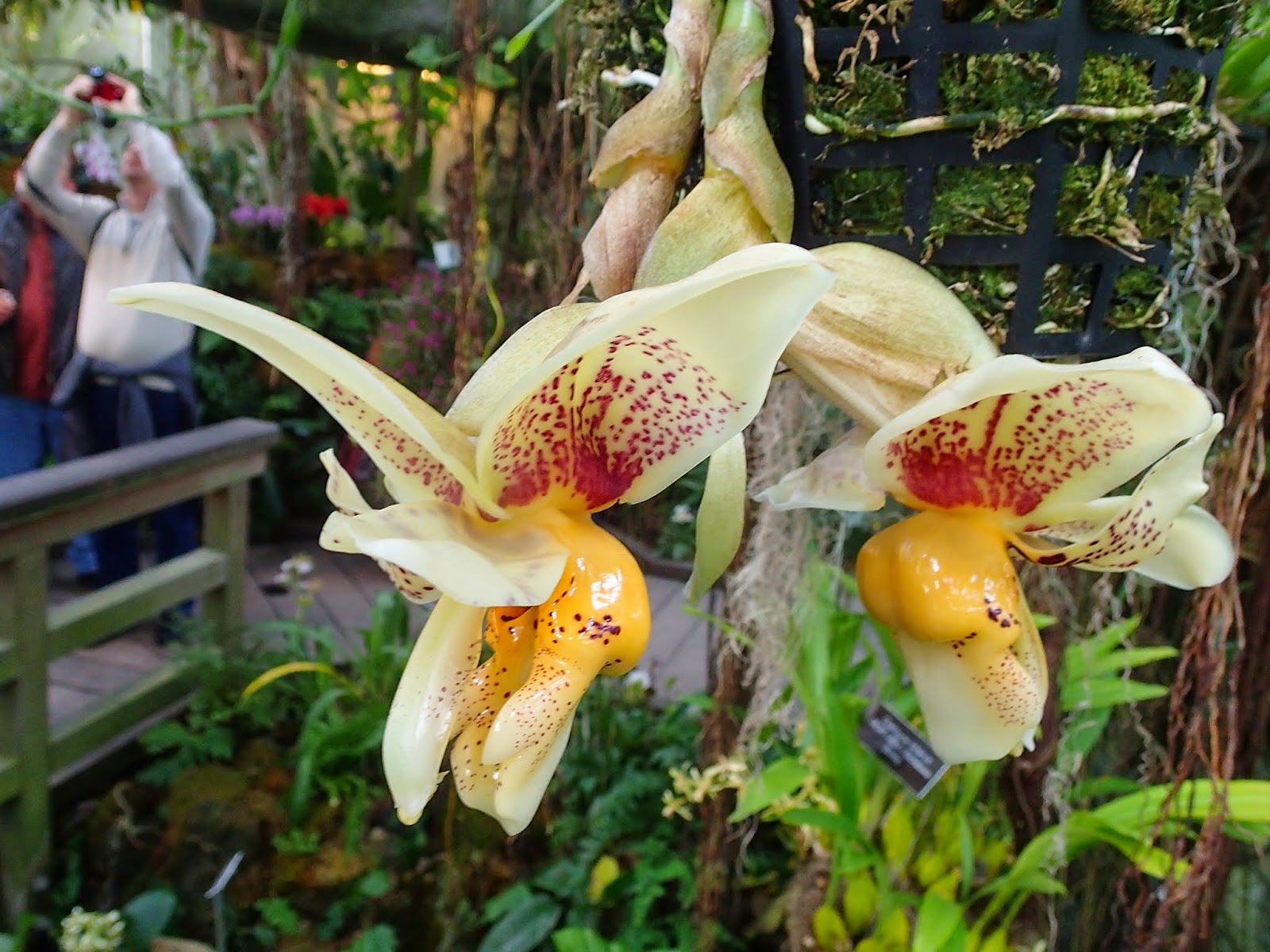
Of course I spent a lot of time perusing the orchid room, reading tags and taking in all of the orchids, big and small. I spent my time taking photos of the Stanhopea on display. Many people walked by me asking questions and commenting on my obvious fixation with the plant. Really, it's really hard not to love the unique, pendulous, waxy, bizarre flowers of the genus. But I digress.

Stanhopea cultivar on display at the U.S. Botanic Garden.
After making my way through the excellent succulent and Hawaiian house, I headed over for a tasty lunch at roti, near George Washington University, and then to the Natural History Museum to take more time in the exhibits (check out the totem poles, guys!). Their photo exhibit honoring the 50 years of the Wilderness Act was incredibly moving. The photos that were chosen were truly stunning and really filled me with a sense of pride in our natural spaces in the U.S., but also frustration at how easy people can overlook such profound beauty.

I didn't get a chance to see the butterflies when I was there in November, so I made a point to get there this trip. I was lucky, since it was a Wednesday the museum was especially slow. I had to pay to get into the Butterfly Pavilion (but it's a small price to pay, considering access to almost 99 percent of the Smithsonian is free!), but I didn't have to wait in line and could spend as much time as I wanted with the beautiful, little creatures. I also hung out with the two young docents in the butterfly enclosure, looking for and identifying butterflies. It was a lot of fun, and I could only pull myself away after an hour with the butterflies. Sadly my camera was dying by this time in the day and the light was harsh, but I was able to capture some of the amazing diversity and behaviors they displayed.

It was a long day and by the end I was worn out, but incredibly satisfied with all I'd been able to experience. I am so very proud to live in a country where we are able to honor such scholastic pursuits, and open and freely share them with anyone who cares to look. What an amazing and priceless gift.

Butterfly hanging out with some yellow Cuphea (I think) in the Smithsonian Butterfly enclosure. This butterfly will spend its entire life in this enclosure, and none of its progeny will have any hope to make it out into the natural world. The Smithsonian is required to destroy all plants removed from the enclosure, according to APHIS sanitation rules. Still, this is an excellent exhibit!

(*I didn't quite agree that GMO labeling is a state issue; but I definitely think that products that contain GMO ingredients, including meats from animals fed with GMO feed, need to be labeled. That would be under the jurisdiction of the U.S. Department of Agriculture though. Write your Congressman/woman. Consumers should demand information about what they are purchasing! ANYway.)

Tuesday, December 9, 2014

Adventures in the Polly Mobile 2: University of Delaware and Driving to Washington, D.C.

It was sad to say good bye to Barb and the wonderful gardens of Delaware, but I had to keep moving on. I was on my way to Washington, D.C.

Herbaceous Garden at University of Delaware Botanic Gardens.
But before my epic leg down the Delmarva Peninsula, I made arrangements with my dear friend Jason Veil to visit the University of Delaware Botanic Garden and to talk about the curatorial assistantship program there.

How Jason and I met is just another testament to how serendipitous horticulture really is. We met by chance as we rode the final bus back to the parking lot after the Woody Plant Conference at Swarthmore College this summer. I think we were talking about the Longwood Graduate Program when he put the bug in my ear about UDel's plant curation program. Little did I know that chance meeting would lead me back around to the university.

So, fast forward to this morning. I got a few extra minutes of sleep, thankfully, and had enough time to say my last goodbyes to the Stremples. I drove down to the garden, checking in with Jason to make sure we were both still undeterred by the cool, grey drizzle. Nothing keeps plant people out of the garden. Jason met me in the parking lot outside of the botanic garden's office with a parking pass, reminding me of the joys nightmares of university parking. After a brief stop in the office, we headed over to see Dr. Frett before he left for the day.

Next was the tour of the garden. It surrounds the agriculture buildings and abuts the dairy, displaying a menagerie of old landscape favorites from the 70s and 80s. There were some impressive specimens, including a maturing Acer griseum, as well as a few who needed some TLC. Overall, there was an interesting story about the fairly recent history of the grounds and how the collections were rooted in teaching plant ID classes. Throughout Jason's fantastic tour, he answered all of my probing questions, and dealt out a couple of jabs at my anti-invasive species comments. There were also some new additions to the gardens, including an impressive removal of some huge hollies and exciting new plantings going in, per Jason's vision as curator. It reminded me a lot of the J.C. Raulston and I can only imagine what the space will look like as it matures. Planting new plants really is an incredible way to show vision.

I highly recommend getting out to see the garden. Although it may be intimidating being on a college campus, it exists as a teaching tool to all, students and members of the community, local and otherwise! Check out the garden's website to find out about parking and upcoming programs, including their plant sale!

So, after my wonderful tour with Jason (and getting some yummy ice cream made at UDel's creamery), I was off down 301, the interstate that snakes down the Delmarva Peninsula, crosses the Maryland state line and the Chesapeake Bay, makes its way to Anapolis and then Washington, D.C. It was a slow, grey afternoon, but it was an easy, incredibly flat, drive. Very little traffic allowed me to look out at the many farms and new developments coming up (which saddened me because of what is to come after that, as I've seen with the land around Charlotte as I've grown up). The bridge to cross the Chesapeake was amazing, so much longer than I thought it would be, and it was a great place to catch the sunset.

And then the traffic began. But, I was okay with it because the highways were now the organized ones of the south (whoo, crossing the Mason-Dixon line!).

My final thought will be to the people of the southern states: be thankful for your roads and how they are organized. Appreciate the many road signs you have. There are those who do not have them, who live in a place where right lanes just end.

Okay, and my post- post-final thought will be check out these awesome musical people: ilyAIMy.

Monday, December 8, 2014

Adventures in the Polly Mobile 2: Mt. Cuba Center and Longwood Gardens


Woods Path, Mt. Cuba Center
The morning was frigid. Armed with ski gloves, I followed Barb to work, winding down the narrow roads of the Brandywine Valley. We came to the elaborate gate of Mt. Cuba Center, previously the Copeland's Estate and quickly climbed the hill of the approach to the house. A quick glance out the right side revealed a vista across the rolling hills in the Valley and to the left a rock garden in the retaining wall! We parked our cars and Barb led me through a tunnel of Rhododendrons and leaning Oxydendrum arboretum. She said she loved parking there because in the spring the Trillium are beautiful. Sadly, the morning was a cold grey and the Rhododendrons' leaves were looking forlorn in the biting cold.

Barb led me across the sweeping brick front of the du Pont-Copeland's beautiful home and went in the front door! Immediately the wealth of the previous inhabitants was evident: elegant wallpaper, hand-carved staircase and crown moulding, rich carpets and beautiful furniture. Every detail was closely tended to. I was reminded briefly of walking into the Biltmore Estate. After meeting several people, Barb led me into the basement where the plant records department was and then took me for a tour of the three story house. I think my jaw was on the floor the entire time. Just wow. And everyone was so welcoming too.

Yet again, once the house tour was done, we decided to head outside to see the gardens. The winter time is not the best time to see a garden at its best, but that doesn't mean a garden shouldn't be seen. Barb decided to check some areas while we were out there, so we bundled up and headed out. We walked through the formal garden and Barb told me about the upcoming renovations, then through the Trial Garden. If you don't see anything else (well, except the Trilliums), the Trial Gardens are worth the trip. Mt. Cuba Center is on the cutting edge of trialing natives and they have an impressive garden to do it in.

The cold slowed us down and we tried to keep moving, but I couldn't help but stop and look closer. Barb led me down the west slope path to the ponds, where we met one of the area gardeners, who stopped to talk with us a bit. We continued on and came to the area that Barb needed to check. Flags were spread throughout the area, and if you looked even closer, so were metal tags. Almost invisible reminders there were plants dormant there. I took the moment to look around me and take in the cathedral-like atmosphere of the Liriodendron tulipifera towering above the lake, and tried to imagine what the garden would look like in the spring, summer, fall when all of the plants would be active, growing in a great chorus in this great church.

The cold got the best of both of us and we made our way back up to the house; around the ponds, through the meadow, the dogwood path and trillium garden, and then up the woods path. I was most impressed even just seeing the bones of the garden and I can't wait to see the gardens in the full glory of spring.

We took a moment to warm ourselves and then we were out again, this time in a golf cart for a tour of the farther-flung areas of the gardens. Barb took me by several areas, until we ended up at the greenhouse facilities. One of the wonderful ladies there gave us both a tour of the facilities and we both learned a lot. There were the challenges of having to both use and maintain aging facilities, but the facilities themselves were interesting for their historical value. You could easily imagine what the cold storage rooms looked like full of bulbs for forcing and what the benches would look like with plants, immaculately manicured and full of flowers, ready to go up to the house. Facilities for the sake of surrounding yourself with beauty and perfection. What an incredible idea.

~~~

After such a wonderful tour and stimulating discussion over lunch afterwards, I was sad to leave the ladies at Mt. Cuba, but I was off for a tour of the curious boxwood (Buxus sempervirens) collection with the boxwood curator at Longwood Gardens. I eventually made it to the production area of Longwood after getting terribly lost. Again. Barrett was so nice though and was very patient with how late I was.

Once I was there I asked him tons of questions and we eventually made it out to the plots. Much like the Hort Field Lab at N.C. State, the production area was like an in-ground nursery, and the Buxus I'd come to see were planted out in rows, Round-up circles around them and metal tags identifying where they'd come from. Come to find out the Buxus sempervirens out there were cuttings taken from wild plants with desirable traits from countries around the Black Sea, from Albania to Azerbaijan (check out this map to see them!). There were dwarf forms, variegation of every kind (viral, chimeric or otherwise), dark green, light green, open forms, tight forms. A good sampling of the genetic diversity of the species. It was hard to tell they were all the same species sometimes.

So, why does Longwood have these specimens? There are many reasons, and historical value and breeding are the main ones. Longwood Gardens has released many cultivars into the horticultural trade, two of which are boxwoods: 'Longwood' and 'Belleville'. There may be more breeding in the future, so keep your eyes peeled for new releases and between now and then you can see them at the gardens.


Okay, okay. So boxwoods may not necessarily be the most stimulating topic, but Barrett had also planned for us to check out the Christmas display. It was obvious in the extravagant trees and decorations in the Conservatories there was every attention to detail, and stunning lights displayed in the giant trees outside were captivating even to adults. There was something new to see at each glance. The stroll through the Conservatories that evening will always stay with me.

Handmade steampunk Cardinal looking proud. The theme of the Christmas was birds.