Saturday, October 20, 2018

Meeting the Thunderbird: Plant Collections Symposium in Vancouver, BC


The Thunderbird stared down at me from above the gateway to Customs. It was an imposing, majestic creature overlooking a hallway full of dioramas of Pacific Northwest woodland scenes and First Nations artifacts in the Vancouver Airport. The symbolism was different from the Native American tribes I was familiar with in the eastern part of the continent….

But I knew this magnificent figure’s gaze was something to heed. This was going to be a trip to remember.

~~~

Botanic garden curation has been a passion of mine since my time with Tom Clark at the Polly Hill Arboretum back in 2014. I have grown and learned a lot since then (thankfully!); but, without the opportunities, guidance and support I got at PHA, I would never have been aware of this very specific field within horticulture.

I attended the APGA’s Plant Collections Symposium at the end of my time on the Vineyard as a capstone to my internship and found it incredibly valuable to my development as a botanic gardens professional. The symposium only occurs every four years, so there was no way I was missing it this time around, even if I was new in my position at Juniper Level Botanic Garden (and I am grateful for Tony for letting me have the time to represent JLBG there!).

The American Public Gardens Association held their annual conference in Hamilton, ON in 2017, and that was the first time I had ever been to Canada. This time the Plant Collections Section had settled on Vancouver, BC. I was excited to explore a new side of not just Canada, but the North American continent.

The Fall color in Queen Elizabeth Park was mind-blowing. People, including myself, wandered around in awe of the incredible shades of red, orange, and yellow.

The trip from Raleigh to Vancouver was a long one. The 3 a.m. alarm was jarring and the disorienting taxi ride to RDU gave the day an air of dreaminess. Was I awake? We ran away from the sun for hours, gliding over the patchwork of farms that covered the heartland of the United States. Three planes later I was riding the Metro from the airport to my AirBnB. It was only 12 p.m. in the afternoon, but I’d been awake for almost 16 hours.

My tired brain refused to go to bed, and instead demanded food and exploration. I was only a couple blocks away from a Vietnamese place and then only a few more blocks from Queen Elizabeth Park, so off I went.

The park was beautiful, and the weather was sunny and clear (apparently, this is quite unusual). Even still, I barely made it past 6 p.m.

Looking down in the garden of Queen Elizabeth Park

~~~


Becky looks down into the canopy of a western red cedar forest at the Capilano Suspension Bridge walkway.


Of course, fate would have it that a dear friend of mine from Edinburgh would be in Vancouver. How could it not be? A chance, very tired, end-of-night post brought us together that Monday before I fell asleep.

Becky and I met up the next morning, and she drove us out to the mountains to experience the views over the city and let me get a glimpse into the cedar forests. If only I had reached out to her sooner! We could have gone much further afield! That’s on me though. Even still, we had a lovely time exploring and hanging out with each other!

Becky dropped me off just in time to join up with the conference mixer at a bar near the conference hotel, where Tom Clark and Elaine Chittendon (of the Botanic Garden at Smith College, who I’d met just four years prior (see the link for the blog post)) were chatting right inside the door!!!

~~~

Click here for more photos and check out the captions 
for more of the story!

Wednesday the conference began at the University of British Columbia. I took the early bus to the campus with all the sleepy morning commuters. The sun hadn’t even risen yet as I made my way across campus to search for a coffee shop. I found one and arrived at the conference site just in time to meet the buses as they arrived from the hotel. Whew!

The morning talks were very stimulating, and the UBC folks kept us entertained with a walking tour of UBC’s campus and an afternoon of rotating sessions before the poster session/mixer. I had a chance to catch-up with some cool folks and meet new people, while also strolling through a beautiful afternoon.

~~~

Thursday’s venue was at VanDusen Botanic Garden and was a packed day of panel discussions and talks. The day was gorgeous outside and the colorful skyline of trees teased us from the wall of windows in the conference hall. It was tough to wait until the afternoon to have a walk through the Garden I took the bus back to the hotel and spent the whole trip talking to Mike Motta about my time at NTBG. He caught me up on all the developments in the last six years. It is amazing how time flies, how some things change and others do not. That evening I hung out with some cool folks for Indian food and drinks (these folks included Jaimie from Newfields (Indianapolis Museum of Art), Tom Clark, Nick Courtens of the Betty Ford Alpine Gardens, and Tim Timbaut from the Huntington!). It was a good night on the town.

~~~

Cecropia leaves contrasts against the geometric panes of the Bloedel Conservatory

Friday was my last full day in Vancouver and I wanted to see a couple more places before I left. Even with a plan, chance messages and meetings sent me on a different path. I ended up crossing paths with Tim and Ian at the Bloedel Conservatory at Queen Elizabeth Park, and walking through the Park with them. We talked about our respective gardens and swapped stories (and found some curious gardening as we walked to the bus stop). Ian and I took the bus to UBC after Tim headed off to the airport, and Ian told me about when he worked for Tony back when he was at N.C. State. We went separate ways, as I went to find Becky for one last gathering. Becky and I walked solemnly through the Cultural History Museum at UBC, and talked about what we saw and shared our collective experiences that we felt were reflecting back at us in the artifacts around us. I ended up joining her on an evening of going-away gatherings. It was quite the zig-zag across Vancouver, but well worth the late night to hang out with Becky on such an occasion.

~~~

Saturday began the same way Monday did: Too early. The Arab gentleman quietly drove me to the airport and deposited me at my gate by 4:45 a.m.. I was really early and had more than enough time to get some coffee and eat the rest of my Indian food for breakfast. I was not looking forward to this day of plan rides…… something about the return to RDU with no one waiting for me depressed me severely. Even still, it was a beautiful day for flying and it went relatively smoothly. A biker-looking guy dropped me back at my house a little before 7 p.m. Thank goodness I had Sunday to recover!

The backbone of the mountains of British Columbia.

Sunday, August 5, 2018

Juniper Level Botanic Garden: The New Gig

The weather was shifting the morning I drove towards the next stage in my life.

I'd driven the stretch between Belmont and Raleigh many, many times during my time at N.C. State. Despite the familiarity, the clouds seemed to change the scenery. My stop at home in Belmont was brief considering how long I'd been away, but most welcome.

And then, just as I had come, I was back on the road to Raleigh, N.C. to begin my new position as garden curator at Juniper Level Botanic Garden. (For those of you who know it, this is the Garden Plant Delights Nursery is associated with....)

I recommend a quick perusal of the JLBG website to gain a sense of the scope and philosophy of the Garden. The collections are quite extensive.... conservatively more than 22,000 different taxa (type fo plant). That is VERY impressive for an area just a little more than 20 acres. Tony Avent founded the Garden in 1988 with a passion for interesting plants and a desire to share them with the world. To speak bluntly, it is really cool to be a part of that.

Tony has been kind to let me stay in the house on the Garden's property while I get settled and took time to show me around the Gardens as soon as I arrived that Sunday afternoon two weeks ago.... and it's been non-stop ever since.

      Click Here to See a Few Photos from the Garden.....

Agave 'Desert Love'

Monday, July 16, 2018

Back to Belmont, NC: A walk through the woods

I promised to revive my blogging habit after much encouragement from the wonderful people in the Mobile community. Many of them were shocked by my leaving and some of them were surprised to stumble upon my blog. I will miss all of them dearly and so, moving forward, this is for them and all of the other folks who I've had to part ways with along the path of life.

My customary 10-hour trip was extended to a three-day visit with friends/horticulturists I'll miss in Alabama. I followed a looped path from Anniston to Birmingham to Auburn on my way up. Stay tuned for the next post to hear about the roadtrip.

~~~

The metallic whir of cicadas and katydids reverberates through the panes of glass in the backdoor. They hum the background track to a summer in Charlotte, North Carolina. The sound penetrates through your head despite your best efforts. I can even hear it echo from the days of my childhood. The symphony/cacophony ebbs and grows with the heat of the day and vibrates from the trees of the eastern deciduous forest. It doesn't sound like Mobile, Alabama anymore.

Looking up into the canopy of a Platanus occidentalis, Eastern Plain Tree

Well, life sometimes just takes a different turn than the one you'd like, and sometimes the best place to go in that moment when things are off-kilter is home. Ask anyone who knows me and they would either say North Carolina or Scotland is home to me. In this case, North Carolina is easier to drive to from Mobile.

A walk in the woods is the best remedy a frizzled mind and get a sense of place, so off we went, Sparky and myself, down the trail behind my friend's house.

The trees in the yard of our childhood had grown exponentially from my memory. Through my travels I now knew their scientific names: Betula nigra, the river birch, and Platanus occidentalis, eastern plain tree.

The woodland trail was just beyond the back gate. The canopy had grown lower to the ground so it was almost like going through a green curtain. Invasive mulberries guarded the edge of the forest and the beginning of a deep slope, which dropped down to a creek now choked with runoff from the construction upstream.


Once I'd ducked inside, my eye was immediate drawn upwards as the forest opened up like a cathedral, but instead of stone it was made of great arches of old beeches (Fagus americana), red oaks (Quercus ssp.) and tulip poplars (Liriodendron tulipifera). I was happy to see the lack of invasive plants in the gully below and even more excited to see the colonies of paw paw trees (Asimina triloba) spreading around. There were even a couple colonies with trees old enough to have fruit on them!

Bloodroot, Sanguinaria canadensis
I noticed herbaceous plants with bear claw-like leaves at the edge of the path as it curved around, and immediately recognized bloodroot, Sanguinaria canadensis. It created an impressive carpet down the steep hillside and my imagination took over as I saw it in full flower in the late winter, as if snow had fallen down the slope. Had this always been there?

Before the trail dropped down the hill, the umbrella-like whorls of Magnolia fraseri leaves rose above me and my heart soared. "Hello there!" I exclaimed. I couldn't help myself. I had never noticed any Magnolias, except the tulip poplars, growing in these woods. I saw a few more young saplings before Sparky had had enough and turned me around to go back.

~~~

My walk taught me something, even in a brief time. I had to let go of what I thought I knew of this North Carolina I had moved back to and experience it anew. Things had changed, times had changed. It was a brand new place compared to what it had been before.

Had I returned home after all? My friends and family are still here, so in them, yes. Everything else? We'll see.

City Hall, downtown Belmont, NC


Sunday, June 25, 2017

Hello from Hamilton, Ontario: the Report from the American Public Gardens Association Annual Conference

Amanda Wilkins, Curator of Collection, Mobile Botanical Gardens

June 19-23, 2017
Butterfly in the Niagara Parks Butterfly Conservatory

Summary
I attended the American Public Gardens Association’s Annual Conference in Hamilton, Ontario (final day photos). More than 500 people from gardens, nurseries, non-profits, and governments from across North America attended. I mainly followed the Plant Collections Development Professional Track during the conference. Evenings were spent either getting dinner with colleagues or at networking receptions. Please see the hyperlinks for more photos.


Take-aways from the Conference
• It was great to meet and catch-up with colleagues in the American Public Gardens Community. I believe it is especially important to physically meet people beyond emails. It makes getting started on projects with people much more visceral.
• Many conference attendees were interested in including the Mobile Botanical Gardens in upcoming garden trips. This is a huge step for us as a garden, as these are the people who will spread the word about us.
• I had offers to write articles for the APGA’s journal. I intend to follow through with this, especially regarding our major collections.
• There are many ways we can play a role on a national level with on-going projects in research, conservation and horticulture. I am excited for these opportunities for the Gardens.
• I learned a lot about the Plant Collections Professional Section and the National Plant Collections Network, which will help aid the Gardens as we move towards getting our Camellia and Rhododendron collections certified. Leaders in the sections have offered to help me as I get started on this project.


Touring the Kayanase Greenhouse
Monday, June 19
Indigenous Plants and Traditions in the Heart of Ontario Tour
We spent the day touring culturally-relevant sites to the Six-Nations Mohawk Native Americans. Sites included: Kayanase, a Native American-led Community Initiative that teaches the community about culturally-relevant plants, and collects and grows native plants to central and southern Ontario and sells them to community members and for ecological restoration projects in and around the reservation; and a community-initiated agricultural project that includes a farmers market, a cooking and preservation class, a 24-hour fresh-food market, and a turtle garden full of culturally-significant plants.

• International Session and Dinner
The opening panel session featured a series of short talks about “Who is your community? People? Plants? Habitats?” and a panel discussion featuring several panelists that included the secretary general of the Botanic Garden Conservation International, the director of the American Public Gardens Association, a representative of the horticulture industry lobbying group AmericanHort, a visitor from New Zealand, the president from the Portland Japanese Garden, and the one and only Dr. Peter Raven. It was a great discussion that lead to great talks over dinner.


Tuesday, June 20
• First-time Attendees Orientation
We got the run-down of how to make the most of the conference and had a chance to do some networking with other new attendees. I saw some familiar faces from N.C. State, but also met a gentleman from Denver Botanic Garden and the director of The Mermaid in California.

• The Plant Requisition System: Automating Data Entry for Plant Records Database
We learned about the system the Chicago Botanic Garden uses to track and accession new plants.

• Sustainable International Collaborations: American Case Studies
Three speakers talked about three different international partnerships they were participating in in regard to research, conservation, and plant trialing. The North American-China Plant Exploration Consortium is a multi-institutional partnership that coordinates and funds trips to the wilds of China to collect and catalogue the Chinese flora. Andrew Bunting talks about how other consortiums he was involved with used NACPEC’s model. Finally, Patrick Griffith, the director of the Montgomery Botanical Center in Miami, FL, talked about his work with three projects in the Bahamas, Belize, and the Dominican Republic. I especially appreciated his method of: Sharing resources, sharing credit, and sharing outcomes.

• Plant Collections Section Meeting
The discussion at the section meeting involved the release of the curatorial ethics policy, the upcoming Plant Collections Symposium in Vancouver, BC in 2018, core documents needed for plant collections professionals, and how we can better share what we’re doing. I had a chance to talk about our work with Rhododendrons and Camellias, and had folks talk to me afterward about this.

• What is a Beacon and Why Does My Gardens Need One?
The gardening social media phone app GrowIt! conducted the session to talk about what the app does and focused on the capabilities of targeted tours using beacon technology. There is potential with this technology for MBG. It alerts people who use the app when they are near the beacons and can help the garden collect demographic information about its visitors. Additionally, people can use the app to go on a guided tour of the garden.

• Opening Reception
It was an opportunity to socialize and network with other attendees. I coordinated with other Polly Hill Arboretum interns to meet up for dinner. We had six interns come, including five of the past seven curatorial interns. It was very exciting.

Polly Hill Arboretum Intern Reunion Dinner! Pictured: Matt Lobdell, Emily Ellingson, Cat Meholic, Tory Stewart, Jaime Morin, and myself.


Wednesday, June 21
• Magnolia Curatorial Meeting
I sat in on the meeting to see when other gardens were doing and what the capabilities are within the group. I believe there is potential for MBG to get involved with growing some of these plants and helping with conservation of sub-tropical and tropical Magnolias.

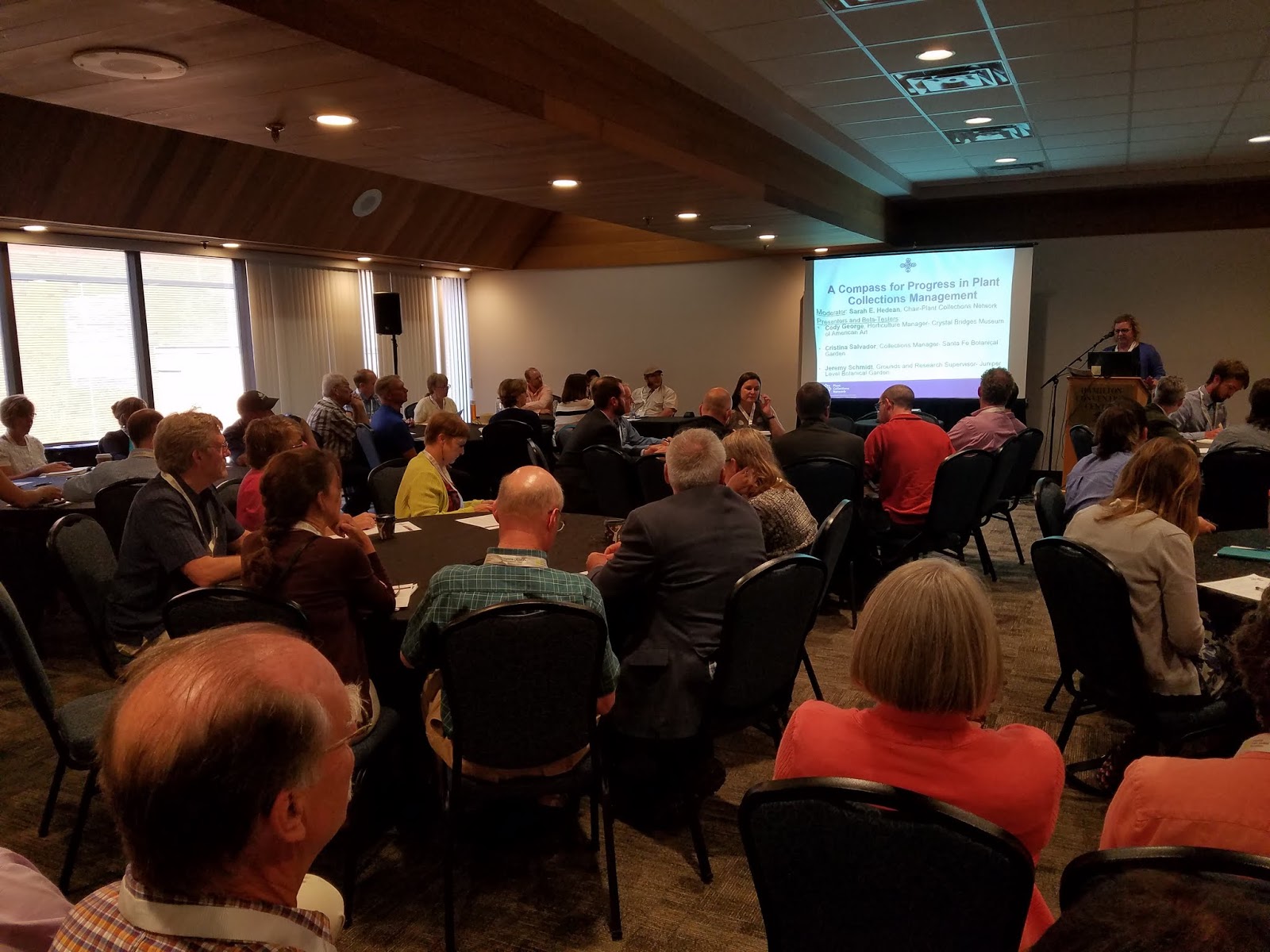
• A Compass for Progress in Plant Collections Section Meeting
This is one of the most exciting sessions of the conference! Section leaders released a preliminary report of a self-assessment tool the Plant Collections Network has been developing to help gardens benchmark their collections and hopefully better prepare for gaining a Nationally-Accredited Plant Collection. I found this to beneficial to helping me start thinking about accrediting our Camellia and Rhododendron collections.

• Keynote Speaker: Colonel Chris Hadfield
I had my reservations about having a retired astronaut as the keynote speaker of a public gardens conference, because what could he have to say to a room full of garden folks. But, Colonel Hadfield turned out to be one of the most relevant speakers. He told a story of how we’re all a part of a world-wide garden, all floating in the same bubble of air and water. It was a fascinating perspective and a hopeful message.

• Introduction to IrisBG
IrisBG is one of the two dominant plant records systems available in the industry today. I am considering this as the system we should adopt moving forward, although I have not formalized this. This session was an introduction to how the system works, and was especially helpful as it was full of folks who mainly use BGBase, which is probably the dominant system available, so there was a great discussion of how the systems compare. I was trained on BGBase, so I know the pros and cons of its usage. IrisBG and the staff have done a great job of responding to feedback from their community.

• Rapid-fire Presentations
I sat in on the first round of presentations to see how it ran. It was a lot of fun and full of presenters and attendees. They covered a lot of ground, but it was interesting. I was especially struck by the news that none of the 7th and 8th graders one of the presenters interviewed knew what a ‘horticulturist’ was.

• Poster Session and Drinks
Several folks stopped by my poster to hear about what my findings were and there was a lot of interest in my topic: “What are Trees in a Botanic Garden Worth?”

Me with my poster.


Thursday, June 22
• Plant Collections Network Forum
This session was focused on folks who have a nationally-accredited collection, but, again, I hope to help MBG join their ranks with our Camellia and Rhododendron. The session centered around discussions. There is potential for partnering with the USDA to help grow species or genus-specific collections for conservation and horticulture.

• Leading Audiences to Take Action: A New Approach from the Field of Conservation Psychology
This was a brief session that focused mainly on a structured exercise analyzing how to help engage and inspire garden visitors to become active in conservation efforts.

• Plant Nomenclature and Taxonomy Section
I sat in on this group to see what work the section was doing. They’d compiled a list of Viburnum cultivars and were looking at other groups to engage with. It was a good group discussion, and there is potential to help the horticulture industry.


• Niagara Parks Tour and Reception
There were many options to tour the park and I chose to tour the Niagara Botanical Gardens. The director of the Horticulture School gave us a tour of the major sites and talked to us about the history of the gardens. The tour ended with a stop in the Butterfly House (!!!) and their restored prairie. After our tour of the garden we got to walk along the Niagara River and then along the rim of the falls.


Friday, June 23
• What Botanical Gardens Can Learn from New, Innovative Urban Parks to Build New Audiences
The session looked at many new parks across the United States and discussed ideas that had proven to be successful for bringing more people into the garden in downtown Oklahoma City.


• Rapid-fire Presentations- This is when I presented
My presentation about the longleaf pine forest at MBG was well-received despite some technical difficulties. Attendees were impressed that we were able to burn, but also the progress that has been made.

• Networking Lunch
I have to admit, I was a little tired by this point, and I wasn’t networking effectively. Even still, I met a lady from North Carolina who’s at a garden I haven’t been to yet.

• Plant Jeopardy!
Of course, since we had all the plant nerds in one place there had to be Plant Jeopardy.


An Afternoon in Paradise: Royal Botanic Garden
The afternoon culminated in self-led tours of the main garden and the newly-renovated rock garden of RBG. I had a chance to catch up with folks for a final good-bye and had the great fortune of walking around the rock garden with the gentleman from The Mermaid I’d met the first morning. A great way to finish off the week.


Saturday, May 20, 2017

Gallery of Gardens 2017 in Mobile, Alabama


The 2017 Gallery of Gardens tour ended today, just in the nick of time before the thunderstorms came. We dodged the weather this year with a successful two-day series of gardens tours through nine private gardens in Mobile, Alabama.

I had the great fortune of making it to five of these gardens (I still had to work too, so five out of nine isn't bad!) before the end. I always enjoy seeing how people interpret the space they have, and love to see what plants strike people's fancy. There were lots of oakleaf hydrangeas in this year's gardens, as well as an excellent palette of textures, and not so much heavy on the use of flowers.

~~~~

Click on the addresses for additional photos:


959 Augusta Street
Bob and Sherry Allen

Bob and Sherry have created an intimate garden in their outdoor spaces around their house. The front of the home easily flows to the backyard through the side gate lined with Boston ferns and confederate jasmine. I loved the pottery birds on the birdbaths. Great little plant vignettes, especially their combination planters that featured a Coleus with a Hosta.


261 Marine Street
Barry and Stevi Gaston

I fell in love with Stevi and Barry's backyard the more I spent time there. They have cleverly balanced the existing concrete with raised beds and planters. Each of their studios (Stevi is a painter and Barry is a potter) opens up to the garden, which features many places to sit and enjoy the many lines of sight through the garden. The koi pond features a fountain that creates the sound of running water throughout the space. They've even created an outdoor shower, so they never really need to go inside!


259 North Jackson Street
Jim Gilbert and Tim Lloyd

Agapanthus is one of my favorite perennials and I have to say, Jim and Tim did an excellent job place theirs in this intimate courtyard space. A large cast iron fountain sits in the middle surrounded by tropical plants in all size pots. They've really got a nice palette of tropicals. I especially loved the light pink oleander on the standard.


255 North Jackson Street
Pete and Renea Burns

It really amazes me how people have carves out spaces to live in the old streets of Mobile. Renea and Pete's home is cleverly disguised from the street behind a climbing fig-covered wall; once you see the door, then you go down an intimate passageway that opens up into their own private garden. A large window looks out into the garden from the home. Again, a lovely fountain (this one full of water hyacinths though!) trickles in the middle of a pond in the center. Their two friendly dogs were lounging and rolling around under two very large specimens of staghorn fern. They accomplished an incredible amount for such a small space.


255 State Street
Kelly Baker

Oh my goodness! If the stately oaks of State Street don't immediately overwhelm you, the hidden gem through the little black garden gate will. Kelly's garden ceiling is made of beautiful oaks, and she's festooned her garden with elegant statuary and lovely green and white combinations. Each little corner of the garden has something going on in it, and everyone who was with me was envious of how open her house was to this little garden. The use of mirrors and a focal art piece (actually painted by Stevi Gaston, another lady on the garden tour!) draw your eye beyond the dimension you're already in.


~~~~

And then to tie up the day, a stop at Roosters for some homemade peach habanero salsa and jerk chicken. Yum!


Sunday, February 5, 2017

Trillium Travels: A Trip to Northern Florida

It seems my springtime traveling fate is intertwined with the flowering of Trillium....

What follows is a truly serendipitous, fortuitous story of when social media comes through:

Back in 2015, I joined Instagram on my way down to Mobile, Alabama where I would live with my grandparents and hopefully figure out what I was doing next. I ended up taking up a position at the Mobile Botanical Gardens, and I encountered plants I never had before. I used Instagram to post photos. That's when Michelle (@michellerecycles, @badassbotanist) commented on my plant identification requests and started following me. It wasn't too long until I posted a photo that Michelle had to ask Gil Nelson (@idigbiogil) to confirm an ID. From then on, we all stayed in touch about various and sundry plants.

Fast forward to December 2016 when I returned to the U.S. I got in touch with Gil to say hello, let him know I'd returned and that I'd love to come visit him sometime. He offered up the idea of a Trillium walk at the end of January or beginning of February. Yes, of course!!

And he made it happen!

I drove up Saturday, February 4 so I could stop by Torreya State Park, one of the few sites in the world where you can see Torreya taxifolia, Florida nutmeg, one of six living species of the genus and one of, if not THE most, critically endangered conifers in the U.S. I have seen it in the collection at the J.C. Raulston Arboretum, but wanted to see it in-situ.

The park was way out in the middle of North Florida, but was well-worth the drive out.

The hilly country around the Apalachicola from the top of a hill.
First Trillium of the Trip! We suspected T. underwoodii.

Click here for more photos of Torreya State Park!

The path I took went down some steep gullies down to the river and I got to see some amazing hillsides of Rhapidophyllum hystrix, Dirca palustris, Trillium underwoodii, Hydrangea quercifolia, Persea palustris and Aesculus pavia. It was a beautiful palette of plants. I got lots of inspiration for a woodland garden.

I stopped by the Gregory House on the way out and had the great fortune of meeting Pam and Bill Anderson, who were a dynamo husband-wife team who've been instrumental in plant conservation at the park. Bill showed me the champion Rhus copallinum, which easily had a 10-inch caliper, while Pam went back to their home and retrieved four cutting-grown saplings of Torreya taxifolia. I look forward to seeing them again.


The next morning I met Gil, Michelle, Jill, and Annika for a day-long road trip to see the four species of Trillium native to Florida.

The group behind the Torreya taxifolia in the left of the screen.
Rumors said that Torreya used to be huge trees! This one is
just a baby.
Click here for more photos of the Trillium Hike!

Our first stop was Angus Gholsom Nature Park, where we saw more Trillium underwoodii, Erythronium americanum, our first Torreya taxifolia group, and Zephyranthes atamasca. Michelle exhibited her mad plant selfie skills with some Trillium and Zephyranthes....


The second stop was just on the other side of the neighborhood and featured Aesculus pavia, Trillium lancifolium, and a few new ephemerals, including an herbaceous Smilax and Cardamine concatenata.

The third stop was on a triangle of woodland just near the dam. They'd done a lot of clearing of invasive Elaeagnus, and the Trillium and more herbaceous Smilax were able to thrive. More plant selfies ensued!

The fourth stop was on the edge of the clear waters of the Apalachicola to see a little hillside of Aquilegia canadensis and Trillium maculatum.

The final stop was at Florida Caverns State Park. Gil led us through down a trail of limestone outcrops on the banks of the Chipola River. The park features an underground tour of some of the caverns, but we stayed above ground to see more plants. There was so much Polemnia laevigata, Sabal palmetto, Sabal minor, and more Rhapidophyllum hystrix.


Monday, November 28, 2016

A Scottish Farewell: Glen Coe and Glen Etive

(1/9/17)- I apologize for the gross delay in a blog post. I have so many stories and such a backlog of photos! I will work on them as I can, but also try to keep moving forward in perspective.

~~~~

It was just by chance, a passing comment, that Raini mentioned that since she was no longer employed, she could do a roadtrip up to Glen Coe. Even now, I am not sure whether she knew at the time how serious I was about wanting to go.

It was fitting that a week before I left Scotland to return to the U.S. that I would come back to the place where I fell in love with the country back in 2003. Goodness, I was a just a 13-year-old then; but the Three Sisters are impressive enough to instill awe in even the most stoic.

The Three Sisters of Glen Coe

I kept on Raini about when she might be able to go on this trip, and we eventually set a date for an overnight trip. Adventure awaits!

She picked me up from the flat in the afternoon in an effort to hopefully catch the sunset in the Highlands. We wound up the winding roads of the Highlands and did catch the last shadows of the sun on the impressive hills.

Hill between Tyndrum and Bridge of Orchy

We ended up staying overnight at the youth hostel in Glencoe (after the GPS getting us lost three times). The darkness of a clear night and mountain valleys enveloped us as we walked down the road to the local pub for food and libations.

The next morning was a tough start with us trying to get up early for the sunrise, with no food or cafes open. It was definitely a lesson in proper planning.

But the day offered beautiful views. The clouds came back, but remained high so we could see the mountains and glens. It was as if Nature herself was revealing her majesty to us. I was able to blow the Beltane callhorn to the Three Sisters and hear the reply of the glen, and Raini was able to start her photography project with Glen Coe as her backdrop.

Modest Beinn a'Chrulaiste overlooking the road to Glen Etive