Amanda Wilkins, Curator of Collection, Mobile Botanical Gardens
June 19-23, 2017
 |
| Butterfly in the Niagara Parks Butterfly Conservatory |
Summary
I attended the
American Public Gardens Association’s
Annual Conference in
Hamilton, Ontario (
final day photos). More than 500 people from gardens, nurseries, non-profits, and governments from across North America attended. I mainly followed the
Plant Collections Development Professional Track during the conference. Evenings were spent either getting dinner with colleagues or at networking receptions. Please see the hyperlinks for more photos.
Take-aways from the Conference
• It was great to meet and catch-up with colleagues in the American Public Gardens Community. I believe it is especially important to physically meet people beyond emails. It makes getting started on projects with people much more visceral.
• Many conference attendees were interested in including the Mobile Botanical Gardens in upcoming garden trips. This is a huge step for us as a garden, as these are the people who will spread the word about us.
• I had offers to write articles for the APGA’s journal. I intend to follow through with this, especially regarding our major collections.
• There are many ways we can play a role on a national level with on-going projects in research, conservation and horticulture. I am excited for these opportunities for the Gardens.
• I learned a lot about the
Plant Collections Professional Section and the
National Plant Collections Network, which will help aid the Gardens as we move towards getting our Camellia and Rhododendron collections certified. Leaders in the sections have offered to help me as I get started on this project.
 |
| Touring the Kayanase Greenhouse |
Monday, June 19
•
Indigenous Plants and Traditions in the Heart of Ontario Tour
We spent the day touring culturally-relevant sites to the Six-Nations Mohawk Native Americans. Sites included:
Kayanase, a Native American-led Community Initiative that teaches the community about culturally-relevant plants, and collects and grows native plants to central and southern Ontario and sells them to community members and for ecological restoration projects in and around the reservation; and a community-initiated agricultural project that includes a farmers market, a cooking and preservation class, a 24-hour fresh-food market, and a turtle garden full of culturally-significant plants.
• International Session and Dinner
The opening panel session featured a series of short talks about “Who is your community? People? Plants? Habitats?” and a panel discussion featuring several panelists that included the secretary general of the Botanic Garden Conservation International, the director of the American Public Gardens Association, a representative of the horticulture industry lobbying group AmericanHort, a visitor from New Zealand, the president from the Portland Japanese Garden, and the one and only Dr. Peter Raven. It was a great discussion that lead to great talks over dinner.
Tuesday, June 20
• First-time Attendees Orientation
We got the run-down of how to make the most of the conference and had a chance to do some networking with other new attendees. I saw some familiar faces from N.C. State, but also met a gentleman from Denver Botanic Garden and the director of The Mermaid in California.
• The Plant Requisition System: Automating Data Entry for Plant Records Database
We learned about the system the Chicago Botanic Garden uses to track and accession new plants.
• Sustainable International Collaborations: American Case Studies
Three speakers talked about three different international partnerships they were participating in in regard to research, conservation, and plant trialing. The North American-China Plant Exploration Consortium is a multi-institutional partnership that coordinates and funds trips to the wilds of China to collect and catalogue the Chinese flora. Andrew Bunting talks about how other consortiums he was involved with used NACPEC’s model. Finally, Patrick Griffith, the director of the Montgomery Botanical Center in Miami, FL, talked about his work with three projects in the Bahamas, Belize, and the Dominican Republic. I especially appreciated his method of: Sharing resources, sharing credit, and sharing outcomes.
• Plant Collections Section Meeting
The discussion at the section meeting involved the release of the curatorial ethics policy, the upcoming Plant Collections Symposium in Vancouver, BC in 2018, core documents needed for plant collections professionals, and how we can better share what we’re doing. I had a chance to talk about our work with Rhododendrons and Camellias, and had folks talk to me afterward about this.
• What is a Beacon and Why Does My Gardens Need One?
The
gardening social media phone app GrowIt! conducted the session to talk about what the app does and focused on the capabilities of targeted tours using beacon technology. There is potential with this technology for MBG. It alerts people who use the app when they are near the beacons and can help the garden collect demographic information about its visitors. Additionally, people can use the app to go on a guided tour of the garden.
• Opening Reception
It was an opportunity to socialize and network with other attendees. I coordinated with other
Polly Hill Arboretum interns to meet up for dinner. We had six interns come, including five of the past seven curatorial interns. It was very exciting.
 |
| Polly Hill Arboretum Intern Reunion Dinner! Pictured: Matt Lobdell, Emily Ellingson, Cat Meholic, Tory Stewart, Jaime Morin, and myself. |
Wednesday, June 21
• Magnolia Curatorial Meeting
I sat in on the meeting to see when other gardens were doing and what the capabilities are within the group. I believe there is potential for MBG to get involved with growing some of these plants and helping with conservation of sub-tropical and tropical Magnolias.
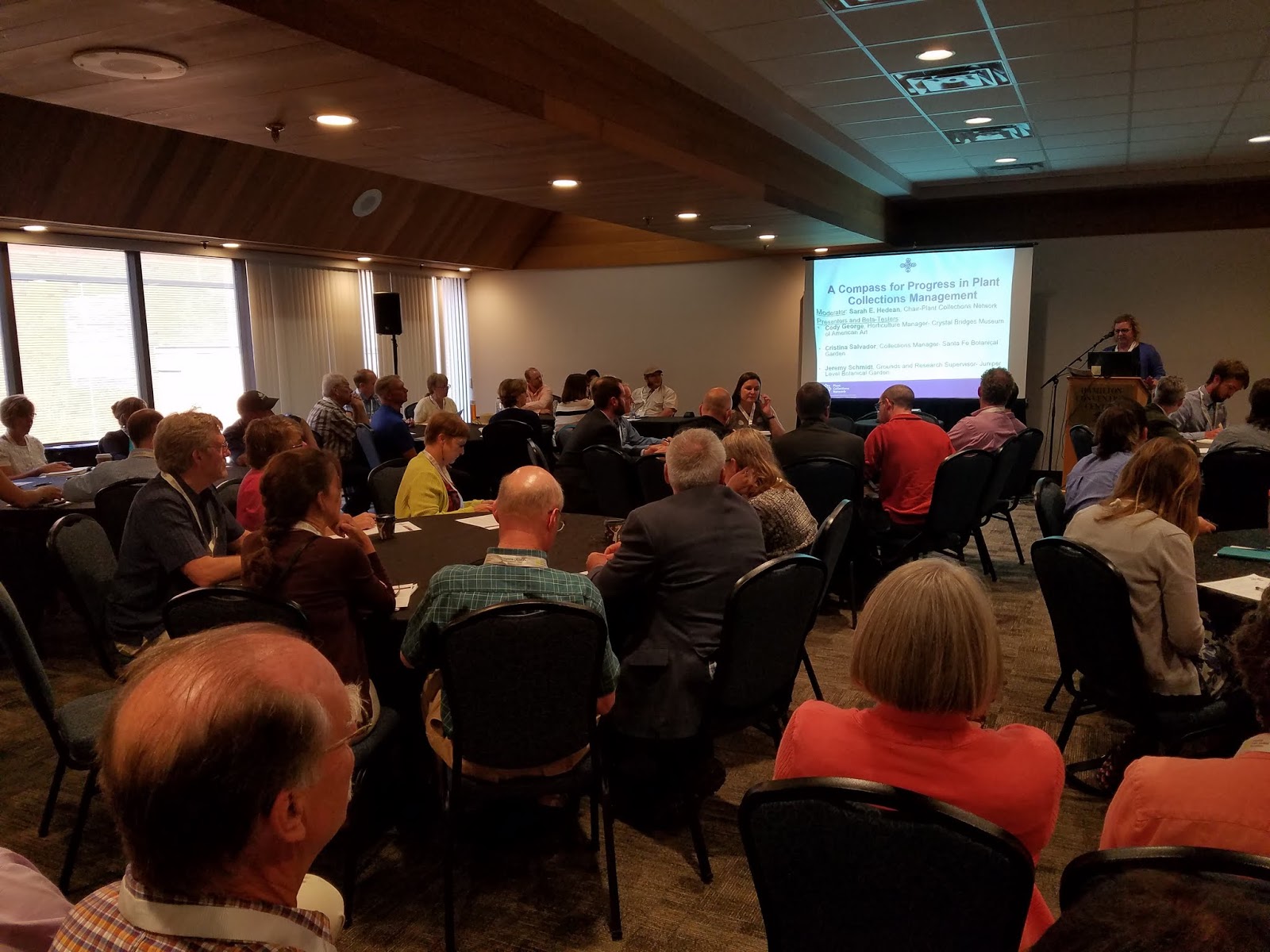
• A Compass for Progress in Plant Collections Section Meeting
This is one of the most exciting sessions of the conference! Section leaders released a preliminary report of a self-assessment tool the Plant Collections Network has been developing to help gardens benchmark their collections and hopefully better prepare for gaining a Nationally-Accredited Plant Collection. I found this to beneficial to helping me start thinking about accrediting our Camellia and Rhododendron collections.
• Keynote Speaker:
Colonel Chris Hadfield
I had my reservations about having a retired astronaut as the keynote speaker of a public gardens conference, because what could he have to say to a room full of garden folks. But, Colonel Hadfield turned out to be one of the most relevant speakers. He told a story of how we’re all a part of a world-wide garden, all floating in the same bubble of air and water. It was a fascinating perspective and a hopeful message.
• Introduction to IrisBG
IrisBG is one of the two dominant plant records systems available in the industry today. I am considering this as the system we should adopt moving forward, although I have not formalized this. This session was an introduction to how the system works, and was especially helpful as it was full of folks who mainly use
BGBase, which is probably the dominant system available, so there was a great discussion of how the systems compare. I was trained on BGBase, so I know the pros and cons of its usage. IrisBG and the staff have done a great job of responding to feedback from their community.
• Rapid-fire Presentations
I sat in on the first round of presentations to see how it ran. It was a lot of fun and full of presenters and attendees. They covered a lot of ground, but it was interesting. I was especially struck by the news that none of the 7th and 8th graders one of the presenters interviewed knew what a ‘horticulturist’ was.
• Poster Session and Drinks
Several folks stopped by my poster to hear about what my findings were and there was a lot of interest in my topic: “What are Trees in a Botanic Garden Worth?”
 |
| Me with my poster. |
Thursday, June 22
• Plant Collections Network Forum
This session was focused on folks who have a nationally-accredited collection, but, again, I hope to help MBG join their ranks with our Camellia and Rhododendron. The session centered around discussions. There is potential for partnering with the USDA to help grow species or genus-specific collections for conservation and horticulture.
• Leading Audiences to Take Action: A New Approach from the Field of Conservation Psychology
This was a brief session that focused mainly on a structured exercise analyzing how to help engage and inspire garden visitors to become active in conservation efforts.
• Plant Nomenclature and Taxonomy Section
I sat in on this group to see what work the section was doing. They’d compiled a list of Viburnum cultivars and were looking at other groups to engage with. It was a good group discussion, and there is potential to help the horticulture industry.
• Niagara Parks Tour and Reception
There were many options to tour the park and I chose to tour the
Niagara Botanical Gardens. The director of the
Horticulture School gave us a tour of the major sites and talked to us about the history of the gardens. The tour ended with a stop in the Butterfly House (!!!) and their restored prairie. After our tour of the garden
we got to walk along the Niagara River and then along the rim of the falls.
Friday, June 23
• What Botanical Gardens Can Learn from New, Innovative Urban Parks to Build New Audiences
The session looked at many new parks across the United States and discussed ideas that had proven to be successful for bringing more people into the garden in downtown Oklahoma City.
• Rapid-fire Presentations- This is when I presented
My presentation about the longleaf pine forest at MBG was well-received despite some technical difficulties. Attendees were impressed that we were able to burn, but also the progress that has been made.
• Networking Lunch
I have to admit, I was a little tired by this point, and I wasn’t networking effectively. Even still, I met a lady from North Carolina who’s at a garden I haven’t been to yet.
• Plant Jeopardy!
Of course, since we had all the plant nerds in one place there had to be Plant Jeopardy.
•
An Afternoon in Paradise: Royal Botanic Garden
The afternoon culminated in self-led tours of the main garden and the newly-renovated rock garden of RBG. I had a chance to catch up with folks for a final good-bye and had the great fortune of walking around the rock garden with the gentleman from The Mermaid I’d met the first morning. A great way to finish off the week.